What you're really paying for in a stage and screen setup is not the gear itself. It is rigging, weight, labour and risk. A printed backdrop looks cheap until someone has to hang it safely above performers, and a projection screen looks simple until the room's sightlines demand a specific size and gain.
The price drivers repeat across every quote: how the scenery flies, how heavy it is, how fast it changes, and who is certified to touch it. Understand those four, and a line item stops being a mystery. This piece breaks down each driver for screens, backdrops and staging equipment, so the next quote reads like a checklist instead of a riddle. Readers following this should also see Voice Acting Careers: What a Booth Session, a Demo and a Deal Actually Look Like.
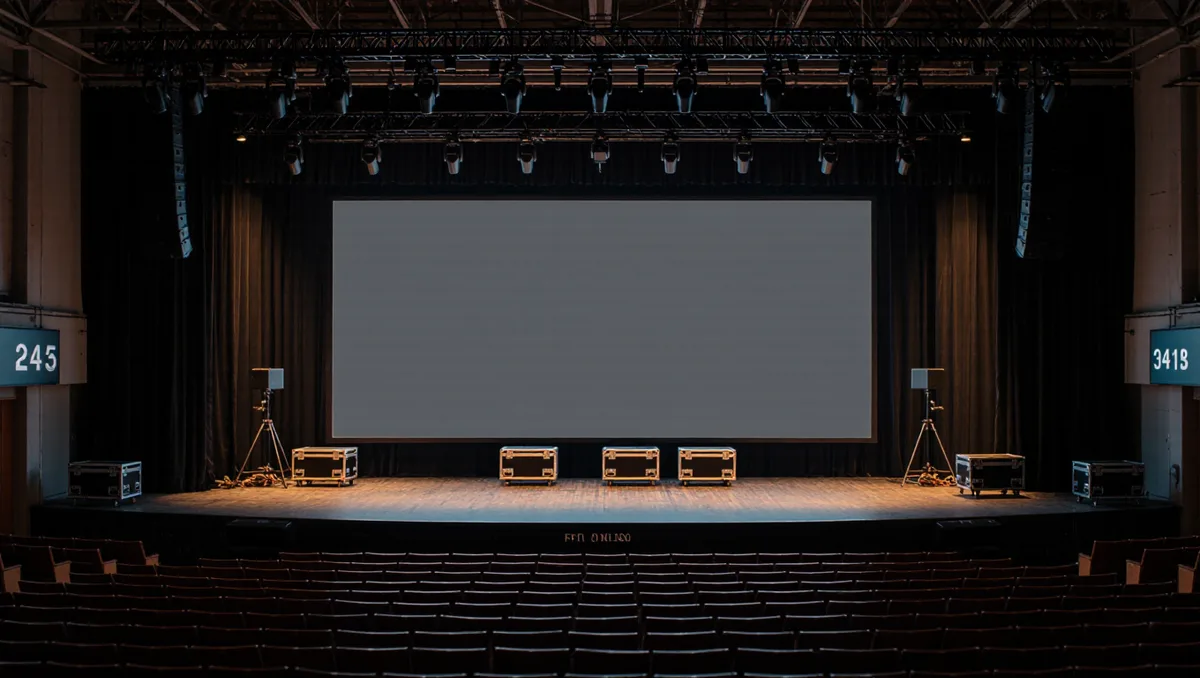
It helps to start with what a stage actually is. As Wikipedia's entry on the stage (theatre) explains, the stage — sometimes called the deck in stagecraft — is a designated performance space, often a raised platform, and the most common Western form is the proscenium stage, where the audience faces one side and the rest of the machinery hides behind the arch. That hidden machinery is exactly where a lot of the money goes.
Why does rigging drive the price more than the backdrop itself?
A backdrop is fabric. Hanging it is engineering. Historically, theatres borrowed pin-rails and pulleys from sailing ships to raise and lower canvas backdrops, with sandbags counterbalancing heavy pieces, and a loft above the stage tall enough to store scenery out of sight. That history matters because modern quotes inherit its logic: the taller the fly space, the bigger the scenery you can store, and the more structure you must build and certify.
Older rope systems, operated by hand, are known as hemp houses, and they have largely been replaced by counterweight fly systems. Counterweight gear costs more up front but moves scenery faster and more safely. When a venue quotes a backdrop, part of the figure is the fabric and printing. A larger part is the battens, pipes, counterweighting and the inspection regime that lets a heavy object hang over people's heads.
What makes one screen cost more than another?
With projection screens, size is the least interesting variable. Three things move the number harder: surface gain, tensioning and mounting. Gain describes how much light the surface reflects toward the audience — a higher-gain surface brightens the image but narrows the viewing angle, so a wide room may need a different material than a deep one. Tensioning keeps the surface flat, because wrinkles read on camera as texture. Mounting is structural: a large screen hanging from a truss or wall needs certified points, and certified points need a certified person.
Rear projection adds another layer. It demands depth behind the surface, controlled light spill, and often a mirror fold to fit the throw distance into the available space. Every one of those is labour, not hardware. The screen itself is the cheapest line on the page.
LED walls change the trade rather than remove it. Panels are modular, so the price scales with area, but the real costs are power distribution, processing, structural support and the technicians who map and colour-match the panels. A wall that looks seamless on show night reflects hours of alignment work you never see.
Why does staging equipment pricing feel opaque?
Because most of it is invisible in the finished look. Staging platforms, decks and risers are priced by load rating, height adjustability and edging. A deck rated for dancers costs more than one rated for a speaker, for the same footprint. Skirting, steps, guardrails and wheelchair-accessible ramps are each separate items, and each adds build time.
Then there is the room. A thrust stage, which extends into the audience with seating on three sides, or theatre in the round, with the audience on all four sides, removes the proscenium arch that hides everything. As Wikipedia notes, the proscenium conceals the wings and lets rigging stay invisible; in the round, every cable, clamp and cable ramp must be dressed or hidden by design. Open configurations buy intimacy and pay for it in labour.
What this means for your next quote
Our analysis of how these quotes break down points to a simple habit: ask what each line item is doing, not what it is. A backdrop quote should tell you the hanging method and who inspects it. A screen quote should state the surface, the throw and the mounting points. A staging quote should state the load rating and the build crew size.
- Ask whether scenery flies, rolls or sits on the deck. Flying costs structure; rolling costs floor space and crew.
- Ask for the surface spec, not the screen size. Gain and tensioning decide whether the image reads from every seat.
- Ask who is certified on the rigging. Unqualified labour is the cheapest line and the most expensive mistake.
- Ask what the changeover needs. Fast scene changes need counterweight or motorised systems, and both price above hand rigging.
None of these questions lowers the price. They explain it, and occasionally they reveal a cheaper route — a deck that doesn't need to fly, a screen that doesn't need rear projection — that a line-item quote would never volunteer.
The craft behind the curtain
It is worth remembering that this pricing discipline is centuries old. Renaissance designers raked stage floors upward to build perspective illusions and make actors visible, then audiences got raked seating and balconies in return. By the end of the 19th century, most stages had level floors again, and most of the audience looked down on the stage rather than up. Each of those shifts was a construction decision with a budget attached, made by people negotiating between spectacle and structure.
That negotiation never ended. A modern screen-and-stage build is the same bargain in newer materials: what the audience sees is the cheap half; what keeps it safe, stable and changeable is the expensive half. Pay for the half you can't see, and the half you can will look better for it.
For performers, the same economics show up on the other side of the footlights — the skills that make a body readable on a stage versus a lens are priced differently too, as we cover in Stage Acting Versus Camera Acting: Why the Same Skill Pays Two Different Ways. And if you follow the wider business of performance, our Stage & Screen section tracks the craft and its costs week to week. We covered a connected angle in Stage Acting Versus Camera Acting: Why the Same Skill Pays Two Different Ways.