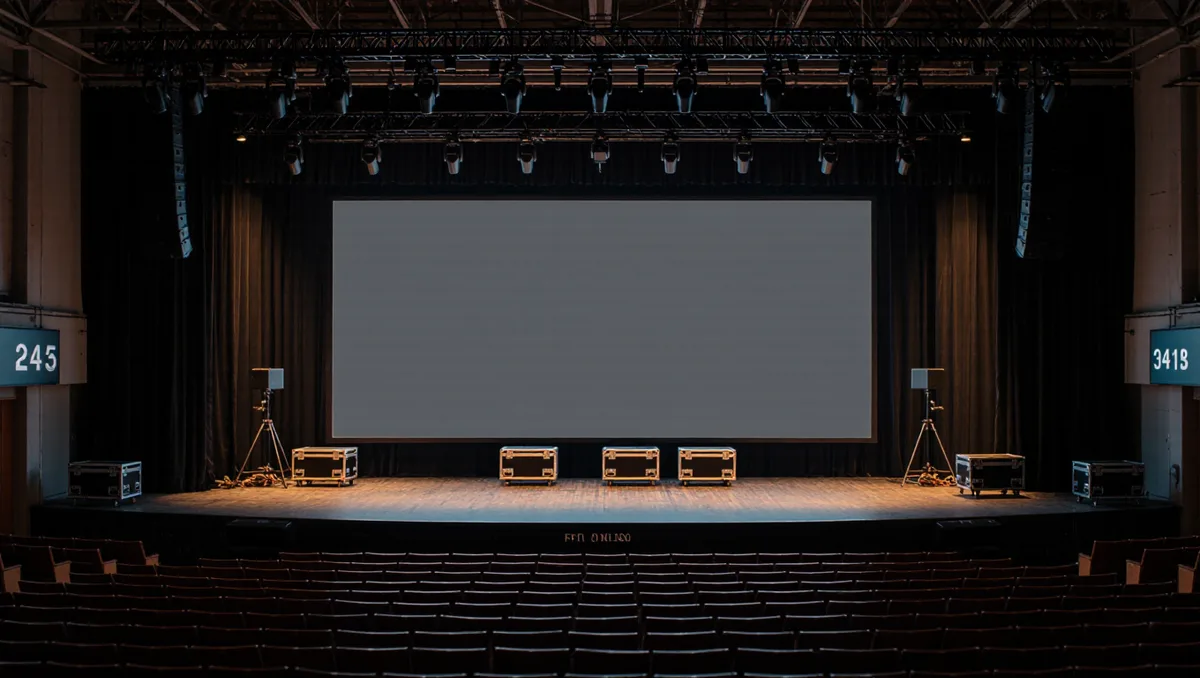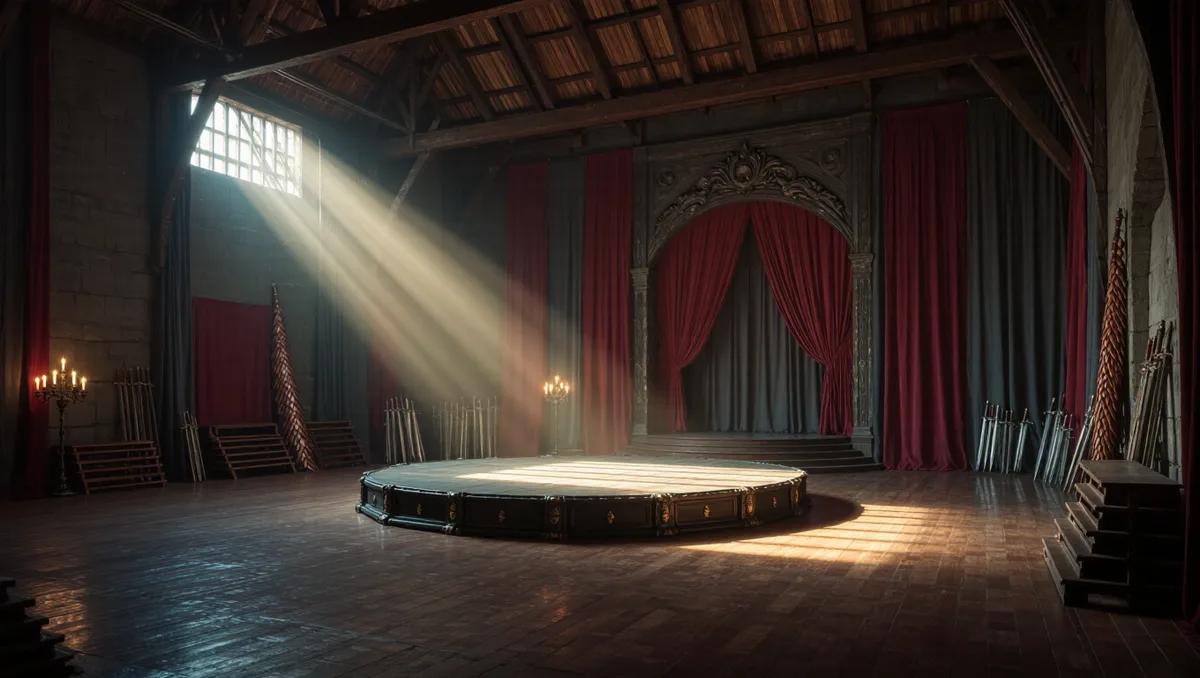
A backdrop starts as a scale drawing and ends as a huge painted canvas that moves on cue, hung from rigging above the stage. The path between those two points runs through drafting, materials, a scenic paint shop, and a rigging crew that treats the thing like cargo, not decoration. Get any one of those steps wrong and the camera or the front row sees a wrinkle where a sky should be.
The stakes are older than film. According to Wikipedia's entry on the stage, court painters in the Italian Renaissance wanted to show more than one perspective background, so court architects adapted the pin-rails and pulleys of sailing ships to unroll, and later raise and lower, canvas backdrops. That borrowed ship hardware is still the ancestor of what hangs over a modern stage and screen studio.
This piece follows a backdrop from sketch to camera-ready, with the craft decisions at each step. If you want the money side of the same machinery, the price drivers behind a stage and screen setup get their own treatment elsewhere on this site. Readers following this should also see What a Stage and Screen Setup Really Costs: The Price Drivers Explained.
Where does a backdrop actually begin?
It begins with the production designer's sketches and a scale drawing, usually called a drafting. The drafting fixes three things: the painted image, the exact dimensions, and the way the piece will be rigged. Nothing gets cut until those numbers are agreed, because a backdrop that is two feet short of the trim height is a reshoot waiting to happen.
The designer also decides what the backdrop has to survive. A stage backdrop lives behind the proscenium, hidden above the stage in the fly loft until its cue. A screen backdrop may hang in a studio, stand as a flat, or wrap a curved frame for a process shot. Same painting, different physics. This connects to our earlier piece, Stage Acting Versus Camera Acting: Why the Same Skill Pays Two Different Ways.
What is the canvas actually made of?
Traditional backdrops are wide-weave cotton or muslin, sewn from vertical panels with flat seams so the paint hides the joins. Heavier scenic canvas holds a sharper image but weighs more, and weight is the rigging crew's problem, not the painter's. For screen work, producers often choose synthetics that resist stretching and photograph with less texture.
Size is the quiet constraint. A backdrop has to clear the proscenium opening with margin on every side, and it has to fit whatever fly space exists. A theatre with a "full-fly" rig can store the entire height of scenery above the visible stage; a "half-fly" space, common in smaller venues, can only store limited sizes, which forces more careful backdrop design from the first draft onward.
How does the painting get done?
Scenic artists work in a paint shop with a floor big enough to lay the canvas flat, because you cannot paint a sky on a hanging surface. The process runs in layers: a prime coat, a grid transfer of the drawing, then blocking in large color fields, then detail. Perspective is checked from the audience's actual sightline, not from standing next to the canvas, which is why scenic painters step back constantly.
Paint choice is technical. Scenic paint is mixed for how it reads under stage or studio light, and for how it ages through a run. A backdrop that looks right under warm tungsten can go dead under daylight-balanced LED, so the paint call is coordinated with the lighting designer before the first bucket is opened.
How does a backdrop get rigged and flown?
Rigging is where the backdrop stops being art and starts being freight. In a traditional theatre, the canvas is attached to a batten — a pipe running the width of the stage — and lifted into the fly loft by a counterweight or rope system. The hardware descends with scenery pieces attached, and the weight of heavy pieces is counterbalanced so a stagehand can move them by hand.
The oldest theatres ran on what are called hemp houses, where stagehands hauled rope lines manually. According to Wikipedia's theatre history, those manual rope systems have been largely supplanted by counterweight fly systems, which trade muscle for balanced loads. Above the stage, several rows of short curtains called teasers hide the backdrops stored in the loft until they are wanted.
For screen studios the rigging is often simpler and the tolerances tighter. A backdrop that sways six inches on stage is invisible; the same sway in front of a camera reads as a fault. So screen rigs add tie-lines, spreader bars, and sometimes a slight forward lean to kill ripple.
What does "camera-ready" really mean?
Camera-ready is a checklist, not a mood. The canvas hangs flat, with no visible seams in frame. The paint reads correctly under the actual shooting or stage light, not the paint shop's tubes. The trim height matches the drafting. The fly cue is timed so the backdrop lands without a bounce. And there is a plan for what happens if a lamp fails mid-scene.
On stage, the last test is the audience's eye. The proscenium arch and the side curtains called legs conceal the wings, so a backdrop only has to be true within the frame the audience sees. On screen, the frame is the camera's, and it moves. That single difference explains most of the extra work a film backdrop demands: the painting has to survive scrutiny from angles the theatre never asks about.
Our analysis: the backdrop is a negotiation
The finished backdrop is a compromise, and the compromises leave fingerprints. The designer wanted a taller sky; the fly loft said no. The painter wanted another day of glaze; the schedule said no. The riggers wanted a lighter canvas; the art said no. What reaches the audience is the version of the image that every department could live with, and that is why two productions painting the same script location can produce backdrops that feel completely different.
That is also why the craft deserves the same seriousness given to performance. A backdrop is not set dressing. It is a moving, load-bearing, hand-painted machine that has to hold an illusion steady for two hours or a twelve-hour shooting day. The next time a scene cuts from a street to an interior without a stitch, the credit belongs to a paint shop floor and a loft full of counterweights.