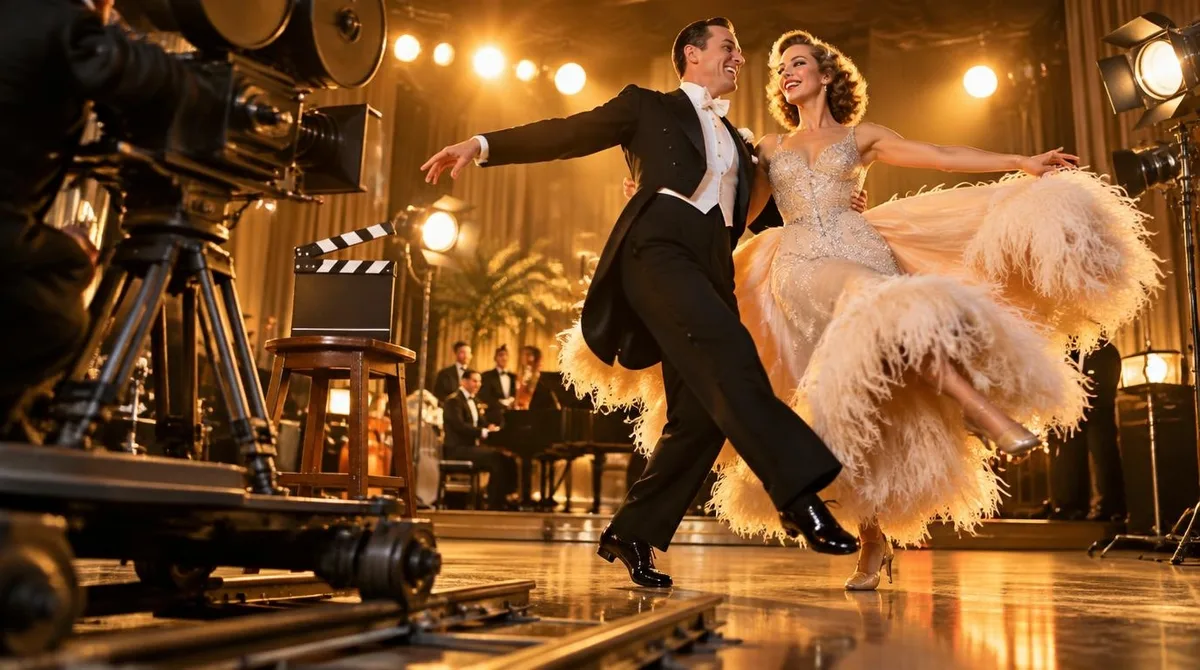
Dance on film asks a plain, hard thing: steps built for a live room must survive a lens and a cutting table. The classic answer came from Fred Astaire who, per standard film histories, held his filmed numbers to four to eight cuts with the dancers in full view, a policy he set in 1934. Everything since has answered the question his way or against it.
The translation is a craft of its own. A camera decides what the audience sees: the whole body, a tapping heel, a row of arms moving in unison. Two studio traditions defined the options. One kept the lens back and the cuts few. The other took the number apart and rebuilt it as montage. Readers following this should also see Conservatory or Street: Two Ways to Train a Dancer.
What Did Fred Astaire Change About Dance on Film?
He demanded restraint from the camera. Fred Astaire insisted that a closely tracking dolly film each routine in as few shots as possible, typically four to eight cuts, with the dancers held in full view at all times. The result was the illusion of an almost stationary camera recording an entire dance in a single shot. He liked to frame the choice as the camera dancing or the dancer dancing, and he chose the dancer.
Why Do Fewer Cuts Protect the Craft?
Long takes keep responsibility on the floor. When no edit can hide a missed step, the whole technique stays in view, and each phrase keeps the shape its maker gave it. A continuous shot also lets an audience study timing, weight and line the way a live house once could. The cost lands in rehearsal, where every count must be clean before the camera rolls. This connects to our earlier piece, Who Runs the Room? The Rehearsal Director's Job.
How Long Did That Policy Last?
Per Wikipedia's entry on the dancer, the rule ran from The Gay Divorcee in 1934 to Finian's Rainbow in 1968. It ended only when director Francis Ford Coppola overruled it on the final film. No other studio rule for dance held that long.
Why Did Busby Berkeley Point the Camera Down?
Berkeley chose the opposite path on purpose. His numbers used top shots, aerial views and dozens of quick cuts, and his close-ups framed rows of faces, arms and legs rather than whole bodies. Per Wikipedia's account, Busby Berkeley cared less about the dancing skills of his chorus girls than about their ability to form attractive geometric patterns. The pattern was the dance.
How Did Montage Redefine What Counts as Dancing?
In the Berkeley model, the edit became part of the choreography. Quick cuts and zooms on a chorus line of arms or legs turned fragments into rhythm, and the kaleidoscope top shot made fifty dancers read as one moving shape. A filmed number could hold moves no stage could hold, because the camera assembled it in pieces. The trade-off is real: dancers perform for slices of frame rather than for the room.
Where Did His Eye for Mass Form Come From?
From drill ground, per the same entry. During the First World War, Berkeley served as a field artillery lieutenant in the United States Army, drilling 1,200 soldiers in complex choreography. Mass formation was a skill he had practiced with men and rifles before he tried it with dancers and props.
Did Full-Body Framing Sell Tickets?
The box office says the restraint paid. Astaire and Ginger Rogers made nine films together at RKO, and six of the nine became the biggest moneymakers on the studio's slate, per Wikipedia's entry on Astaire. That is commercial weight, not just craft preference. Audiences paid to watch complete dancing, and the framing that protected the steps also sold the tickets.
What Do the Two Schools Mean for Working Dancers?
The hiring signals differ in plain ways.
- Long-take shoots reward clean, repeatable full-body technique, since the camera holds every count in view with no cover.
- Montage-heavy numbers reward precision inside patterns, uniform lines and patience to repeat fragments for each setup.
- Rehearsal weight shifts with the style: one continuous shot front-loads the work, while an edited number spreads it across the shooting schedule.
Conclusion: The Camera Is Part of the Choreography
Dance on film works when camera work and steps are designed as one craft. Astaire proved that restraint protects it: few cuts, full bodies, a dolly that follows rather than leads. Berkeley proved that the lens can build a dance no stage could hold. Every filmed number since has picked a point between those poles, and working dancers still train for both.