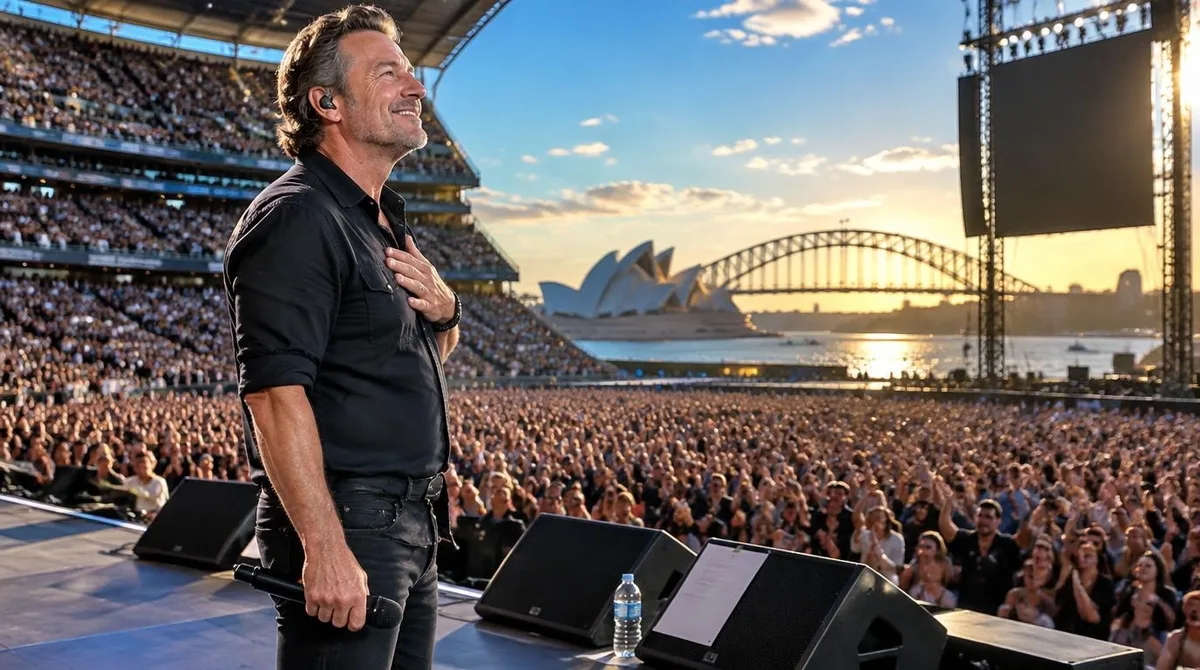
Robbie Williams told a Sydney audience that his wife and four children "saved" his life. Speaking on stage during the Australian leg of his BritPop World Tour, the 52-year-old former Take That star said his kids only care whether he is with them, not about stadiums or record sales. His wife of 16 years, Ayda Field Williams, and their four children, he said, gave his life meaning after years of feeling lost.
The moment is worth more than a news cycle. It is a rare public statement from a performer at the top of the ticket about what keeps the job sustainable: not the money, he said, and not the glory. For anyone who performs for a living, or reports on the people who do, the family-and-career question is one of the most durable in the business. This guide pulls the lasting lessons out of one night of news from Sydney.
Williams, who has well-documented struggles with substance abuse and mental health, framed fatherhood as the thing that gave him purpose. "Before I had my family, I didn't know what I was doing here. I was lost. I was loud, successful maybe, but completely lost," he said, according to Music-News.com. "And then they arrived, one by one with their tiny hands and their massive hearts, and they didn't care about stadiums, and they didn't care about record sales. My kids only care if I am with them. My four kids and my wife saved my life." This connects to our earlier piece, Dance Music — The Anatomy of a Dance Song: Why Some Tracks Move Everyone. This connects to our earlier piece, Dance Music — The Anatomy of a Dance Song: Why Some Tracks Move Everyone.
What did Robbie Williams actually say on stage?
He mixed self-doubt with gratitude, and the contrast is the story. Williams told the Sydney crowd he sometimes wondered whether it was time to pack up his performance costumes, joking about whether his best days were behind him and whether he was "just the fat dancer from Take That?" Then he pivoted: looking at the audience reminded him why he does this, and he said plainly that it is not for the money or the glory. It is because he has four kids and, in his words, needs to get out of the house.
The joke does real work. A veteran performer, still headlining a world tour in his fifties, still voices the same doubt any working dancer or actor feels before a call time. Naming it out loud, in front of thousands of people, is itself a craft move: it converts private anxiety into shared material, which is what entertainment is, as Williams put it, about making people feel something.
Who is in the Williams family, and why does it matter here?
The specifics matter because they show a family built across the exact years a tour career usually frays. Williams shares four children with Ayda Field Williams, 47: daughter Theodora, known as Teddy, 14; son Charlton, known as Charlie, 12; daughter Colette, known as Coco, 8; and son Beau Benedict, 6. The couple has been married 16 years.
Read that timeline against a touring life and the arithmetic is sobering. Sixteen years of marriage spans the decline from late-twenties pop dominance to the veteran circuit, the reunion-era economics, and now a world tour in a performer's fifties. The family, in his telling, is not a side story to the career. It is the structure the career hangs on. For related coverage, see Dance Classes Near Me — Adult Dance Classes: How to Start Late and Actually Stick With It. For related coverage, see Dance Classes Near Me — Adult Dance Classes: How to Start Late and Actually Stick With It.
What can working performers take from this?
Three durable points sit inside the Sydney remarks, none of them dependent on stadium-scale fame.
- Purpose outlasts applause. Williams located his reason for performing outside the performance: his children's presence, not the crowd's approval. A performer whose only metric is audience reaction is exposed on the nights the room is flat.
- Success does not settle the question of meaning. He described himself as loud and maybe successful, but completely lost, before his family arrived. Chart positions and ticket sales, by his own account, answered nothing.
- Humor is a survival tool. He turned his own doubt into a joke the crowd could answer. Self-deprecation on stage costs nothing and buys connection, a technique available to a performer at any level of the bill.
Why does the doubt never fully go away?
Because the job is structured around it. Williams asked Sydney directly whether he still had it. That question is not a fifty-two-year-old's problem; it is the standing condition of performance work, where every night is a fresh audition and the audience's memory is short. The honest answer, which Williams modeled, is to name the doubt and then point at something sturdier than the room. For him, that is four children and a wife who, he said, saved his life.
For performers building their own scaffolding, the practical version looks less dramatic: a reason to do the show that exists whether or not the show goes well. The dance world talks constantly about technique and training, and rightly so. What Williams's night in Sydney adds is the other half of the ledger, the private architecture that makes the technique worth deploying night after night.
What happens next on the tour?
The Sydney show was part of the Down Under leg of the BritPop World Tour, and Williams's remarks were delivered on stage during the concert, according to Music-News.com. Whether the candor becomes a fixture of the remaining dates is unknowable from here. What the evidence establishes is narrower and more useful: a performer with nothing left to prove still gets up each night wondering if he has still got it, and still finds the answer at home rather than in the room.
That is the lasting takeaway from this week's entertainment news. Careers in performance are built on talent, training and luck. They are kept standing, if one of the most experienced performers in pop is to be believed, by the people who do not care about any of it.