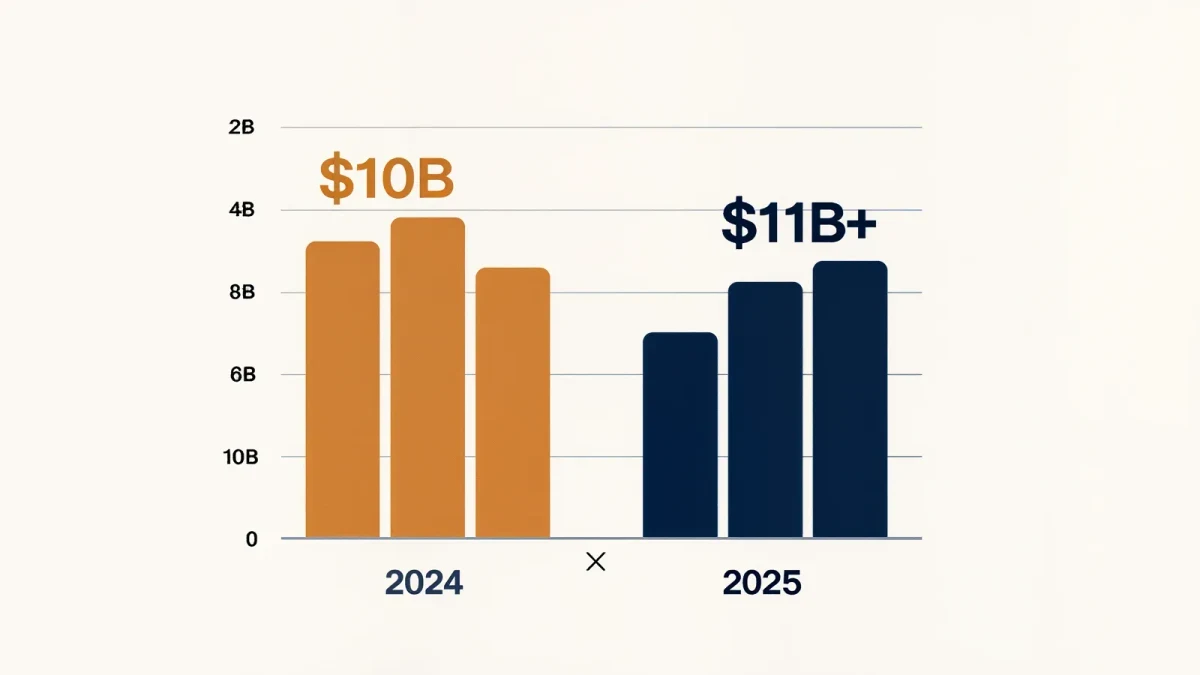
How much does one stream pay an artist? The honest answer is that no per-stream rate officially exists. Streaming platforms pay a share of their revenue into a licensing pool, the pool is split by market share of total streams, and everything else — the often-quoted figures of roughly $0.003 to $0.005 per stream on Spotify or $0.007 to $0.01 on Apple Music — is a backward-calculated average that varies by country, subscription tier and listener behavior. Spotify's own Loud & Clear reporting put total payouts to the music industry near $10 billion for 2024, the largest annual figure the company has disclosed, yet the median artist earned a fraction of that, because the distribution of streams — and therefore of money — is extremely top-heavy.
Understanding the pipe matters more than arguing about averages, so here is the pipe.
What is the pro-rata model?
Nearly every major streaming service uses revenue sharing, often called pro-rata. The platform collects subscription and ad revenue, pays out a contracted share — commonly cited around 60 to 70 percent — to rights holders, and that pool is divided according to each rights holder's share of total plays in a period. If an artist accounts for 0.0001 percent of all streams on the platform in a month, they receive 0.0001 percent of the payout pool for that month. The consequence surprises people: a subscriber who listens to nothing but one unsigned band does not send their whole $11.99 fee to that band. Their fee enters the same pool everyone else's does. User-centric payment models, where a subscriber's money follows only the artists they play, have been piloted — Deezer and SoundCloud ran versions in France and elsewhere — but as of 2025 the industry standard remains pro-rata.
Where does the money go after the platform?
Two parallel streams of money exist, and artists who do not understand the split leave one of them behind. The recording side: platform to label or distributor, then to artist under their contract, with indie distributors passing through most or all of it after fees. The songwriting side: performance royalties via PROs such as ASCAP, BMI and SESAC, mechanical royalties via The Mechanical Licensing Collective in the US — operating since January 2021 under the Music Modernization Act — and international collections through society-to-society agreements. A self-released artist who also wrote the song earns from both pipes; an artist who only performs on a track they did not write earns from neither pipe automatically and depends on their agreements.
Why did Spotify add a 1,000-stream threshold?
In November 2023 Spotify announced changes that took effect in early 2024: tracks must reach 1,000 streams across a twelve-month window before they generate recorded royalties at all, with the withheld amounts redistributed into the general pool rather than kept by the platform. Spotify framed the move as attacking artificial streaming and administrative overhead on tracks earning cents; the Artists' Rights Alliance and some independents criticized redistribution into the pool rather than to the tracks it was earned on. The practical effect for working musicians is small but real — background tracks and back-catalog filler that earned a few dollars a year now earn nothing — and it pushed distributors to flag artificial-stream warnings more aggressively.
Do distributors change what you earn?
On the recording side, yes, materially. Entry-tier distributors charge flat annual fees and pass through the full royalty; per-release models charge once per upload; legacy-style deals take a percentage, commonly 15 percent. The difference compounds with catalog size: an artist with forty tracks pays very different annual overhead under each model. Fine print matters more than headline pricing. Some services charge takedown fees, some withhold against minimum balances, some charge for payouts under a threshold, and contract terms on what happens if you switch distributors — and how quickly your catalog re-delivers to platforms — vary widely. Trade reporting through 2024 and 2025 described several distributors adding artificial-streaming penalties that deduct suspected fraudulent plays from the whole account, which makes reading terms a paying skill rather than a legal formality.
How long do payouts actually take?
Streaming money runs on a reporting lag of roughly two to three months. Spotify, for example, reports plays for a given month and settles on a schedule that means an artist sees March money in early summer. Distributors add their own cycles on top: some pay instantly when funds land, others hold minimum thresholds of $10 to $50. Publishing money travels slower still — PRO distributions run quarterly or semi-annually, and international mechanical royalties can take a year or more to surface. Artists planning release calendars on royalty income need to budget around a full quarter of lag at minimum.
Does stream count equal income?
Not without knowing where the streams happen. A stream in the US or UK from a premium subscription pays several times more than a stream from an ad-supported tier or from markets with lower subscription pricing, because the per-stream average is just revenue divided by plays. Ten thousand streams concentrated in high-value markets can out-earn fifty thousand spread across low-rate tiers. This is why tour routing and release marketing that target specific countries show up in royalty statements so clearly, and why managers watch listener-location data as closely as raw counts.
What should an independent artist do right now?
The mechanics reward housekeeping. Register with a PRO and claim works at the MLC — unclaimed matching royalties are the industry's best-documented free money, and the MLC has distributed hundreds of millions in historical unmatched royalties since 2021. Choose a distributor whose payment schedule and fee structure you have actually read. Watch for the next structural fight: several industry bodies keep pressing for user-centric payout pilots, and any shift there would rewrite whose catalog earns what, especially for niche genres with devoted listeners.