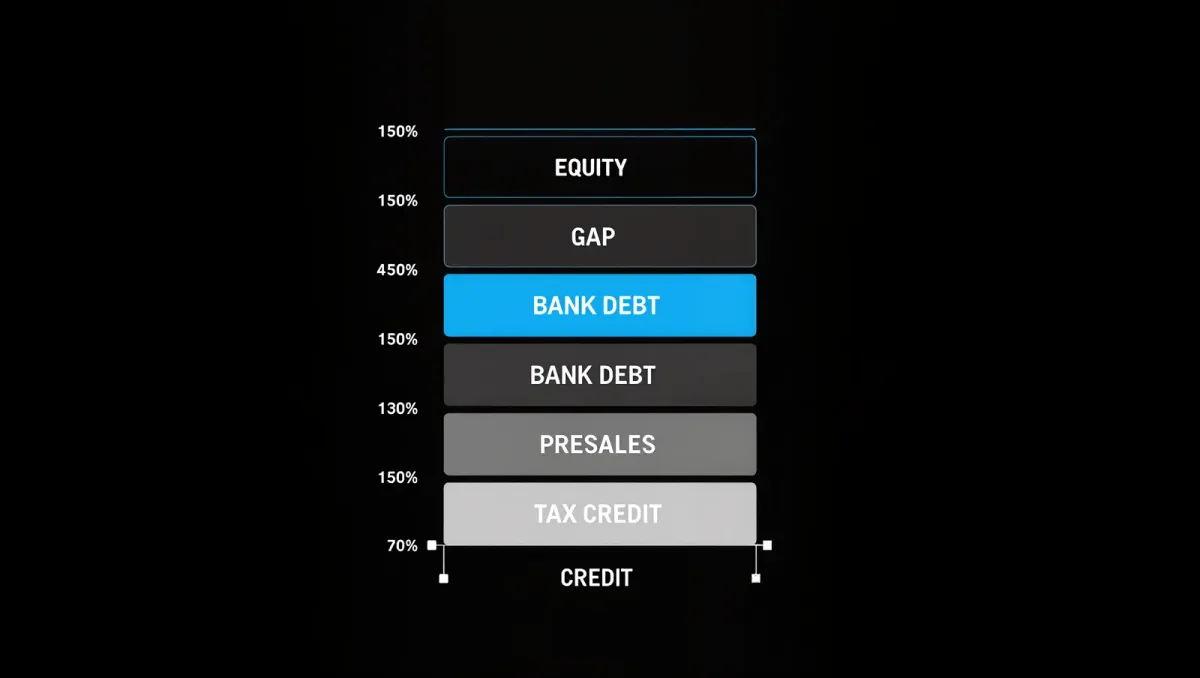
A typical independent feature is financed like a building: layered, with each layer senior to the next. A common structure for a $3 million US indie splits into equity from private investors, foreign presales against distribution rights, state tax credits worth up to 30-40 percent of qualifying spend, and a bank loan against the combination — and the producer's closing memo lists every piece before a single scene shoots.
What is equity, and what does an indie investor actually buy?
Equity investors put cash into the production company in exchange for an ownership share and, in most structures, a recoupment position: they get their money back first from revenues, then participate in profits. Since the SEC's Regulation Crowdfunding rules took effect in 2016, some independent films have raised investment from non-accredited investors through registered platforms, within annual offering limits — a structure the SEC regulates under federal securities law. Film equity remains a high-risk asset class; industry practice prices most indie features as long shots, which is why experienced producers lead with the secured layers.
How do presales and gap financing work?
A presale sells distribution rights for defined territories — a German streaming right, a Japanese theatrical right — to distributors before the film is finished, in exchange for agreed payments on delivery. Sales agents package those deals at markets like the European Film Market in Berlin or the American Film Market. A bank specializing in entertainment lending then advances against the presale contracts, discounting for risk. When the projected presales cover less than the budget, the shortfall — the gap — can be borrowed against the unsold value of worldwide rights, at higher interest, which is why gap money is the most expensive layer in the stack.
What do tax incentives contribute?
Nearly every US state runs a film or TV tax credit program, refundable or transferable, typically calculated as a percentage of qualifying in-state spend. Producers budget the credit as soft money, then sell the credit to a buyer for immediate cash — usually at a modest discount — or borrow against it. The incentive geography decides where films shoot: a 30 percent-plus credit can move an entire production across a state line, which is why production hubs compete by raising their caps and percentages in legislative sessions.
Where do streamers fit?
A streamer acquisition collapses the puzzle: a flat purchase price, paid against delivery, with the platform taking worldwide rights. For producers, the trade-off is certainty versus upside — no presale puzzle, but no backend if the film breaks out. Festival acquisitions of the past decade, where a Sundance premiere triggers a multi-million-dollar bidding war, are the visible tip of that model.
What is the recoupment order when the film earns?
Standard waterfall: sales agent fees and expenses, then the senior bank debt, then tax credit financiers, then equity with a premium, then profit participation split among investors, producers and talent. Deferred fees — cast and crew working for scale plus a promised share — sit near the bottom, which is why deferrals are considered the filmmaker's own risk capital. An indie that fully repays its equity is, by industry convention, already a success story.
What is next for indie financing?
Spring markets set the packaging pace for the rest of the year, with sales agents building slate lineups ahead of the fall festival season and AFM. For filmmakers, the durable rule holds: raise the soft money first, the bank debt second, and ask equity to come in last — because in this structure, the last check in is usually the first one out.
How does the development phase get funded?
Before any of the stack, someone pays for the script, the casting attachments and the packaging materials — the development money, usually the producer's own or a development fund's, and the layer most likely to never recoup. Development costs are small relative to production but decisive in quality: a professional line producer's budget, a casting director's attachments list and cleared chain of title are what separate a financeable package from a screenplay with a wish list. Sales agents routinely reject projects on packaging weakness alone — a director without a delivered film, a cast without territorial value — which is why experienced producers spend development money on credibility documents rather than more script drafts. Grants and lab placements from film institutions add soft development funding, plus legitimacy that sales agents read as a filter.