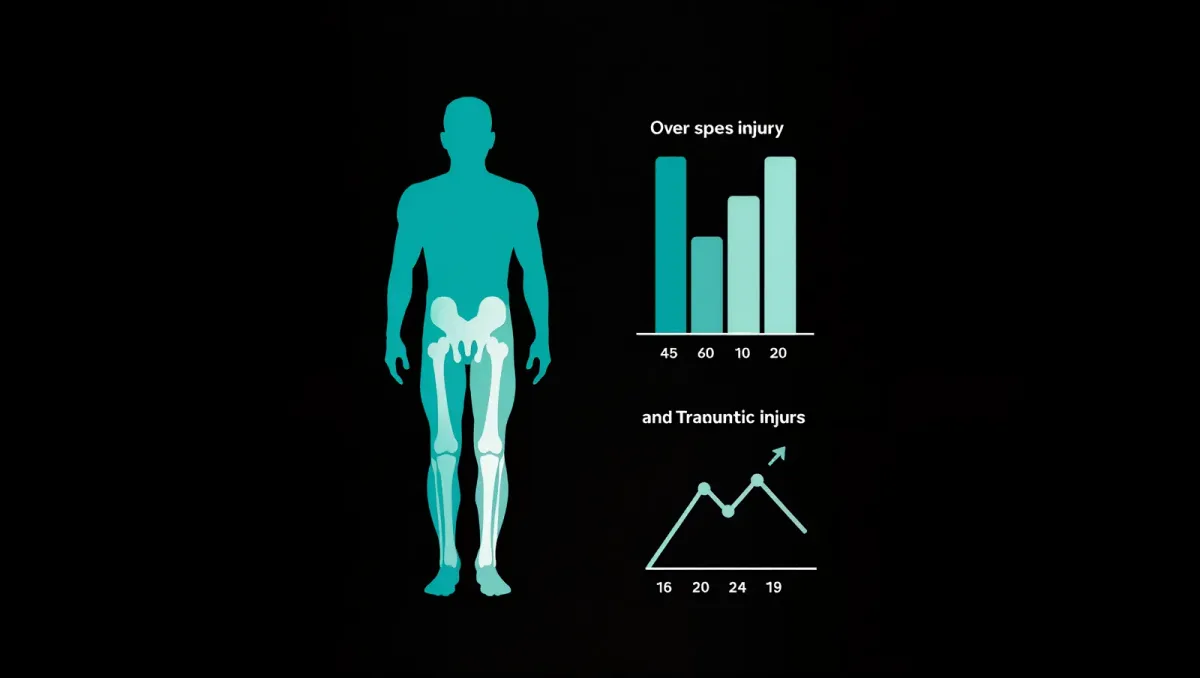
How common are injuries among professional dancers? Common enough that dance medicine became its own research field. Peer-reviewed studies of professional ballet and contemporary companies have reported that the large majority of dancers sustain at least one injury per season, with overuse injuries dominating and the ankle and foot the most affected regions; published injury-incidence figures across studies typically fall in the range of one to two injuries per 1,000 hours of dance, rising sharply for professional companies where dancing hours are high. Behind the numbers sits a practical consensus that has changed how companies and studios operate — and, for dancers, a set of prevention protocols with actual evidence behind them.
Which injuries dominate the data?
Three patterns repeat across the literature. First, overuse beats trauma: most injuries are not single-accident sprains but cumulative-load problems — tendinopathies, stress reactions and stress fractures, particularly in the foot and lower leg, where repetitive jumping and pointe work concentrate force. Second, the ankle is the leading injury site, with lateral ankle sprains the most common acute injury in dance as in sport; insufficient recovery from a first sprain is a documented risk factor for chronic instability. Third, the lower back and hip figure prominently in styles with deep spinal and hip work, and contemporary research increasingly includes psychological load — schedule pressure, audition stress — as a measured contributor to injury risk.
What are the documented risk factors?
Research points to a stack of manageable factors rather than one cause. Training-load spikes — sudden jumps in rehearsal hours before premieres, competitions or tours — are among the most consistently cited triggers for overuse injury across sport and dance science. Energy availability matters: studies of dancers and other aesthetic athletes document restricted eating patterns and low energy availability as risk factors for stress fractures and endocrine disruption. Prior injury, sleep debt and late-adolescent dancers on professional schedules add documented risk. Floor surface, footwear fit and choreographic load per week round out the modifiable list — meaning most of the serious risk factors are things companies, studios and dancers can actually change.
What prevention actually works?
The evidence supports a short list. Neuromuscular training programs — balance work, ankle stability and landing-control drills integrated into warm-ups — reduce ankle and knee injury rates in controlled studies of athletes and have been adapted successfully for dancers. Graduated workload management, including monitoring of jumps per session and pointe hours, targets the load-spike mechanism directly. Screening programs that catch deficits before season — ankle range, previous-injury history, strength asymmetries — are standard at well-resourced companies. Nutrition support aimed at maintaining energy availability addresses the stress-fracture pathway. None of this is exotic; the research finding is more that basic protocols, applied consistently, outperform heroic interventions.
How has company practice changed?
Measurably. Major companies now employ or contract physiotherapists and athletic trainers embedded in daily class and rehearsal — a model pioneered in dance medicine programs at hospitals and universities from the 1980s onward. Scheduling research has influenced practice: many companies moved toward mandatory rest days, capped consecutive performance runs and structured return-to-dance protocols after injury, replacing the old culture of dancing through pain that veteran companies have publicly worked to change. Studio-level practice lags the professional tier — most recreational and pre-professional dancers still train without medical support — which is where the research translation gap sits as of the mid-2020s.
What should a dancer track themselves?
The self-monitoring behaviors with research backing are simple. Watch load spikes: if rehearsal hours double for a production week, treat it as a risk event and add recovery. Treat persistent pain that alters technique as information, not weakness — the documented pattern is that delayed reporting turns a two-week problem into a season. Maintain strength and balance work outside technique class, since technique alone does not build the capacity that prevents ankle injuries. And take sleep and nutrition as training variables, not lifestyle extras; both appear repeatedly in the injury-risk literature.
What does a proper return-to-dance protocol involve?
Modern protocols replace the old binary of full rest versus full return with staged criteria. A typical progression after a significant injury moves through pain-free daily activity, technique fundamentals at reduced hours, graduated rehearsal participation with movement modifications, and full performance only after objective tests — strength symmetry, jump-landing control, endurance — are met. Companies with medical staff clear each stage; independent dancers can approximate the structure with a physio familiar with dance demands. The research rationale is re-injury risk: returning to full load before capacity is restored is among the strongest predictors of recurrence, especially for ankle sprains. The cultural change is the point — protocols turn comeback decisions from a negotiation with guilt into a checklist.
What is next in dance medicine?
The live research fronts into 2026: wearable-based load monitoring adapted to dance movement, which standard sport science tools handle poorly; better data on non-ballet genres — hip-hop, breaking, commercial styles — whose injury profiles differ from ballet's and whose dancers historically lacked studies; and growing attention to psychological load and burnout. The field's direction is consistent: dance injuries are managed risk, not fate, and the companies and studios that treat prevention as infrastructure are the ones whose dancers last.