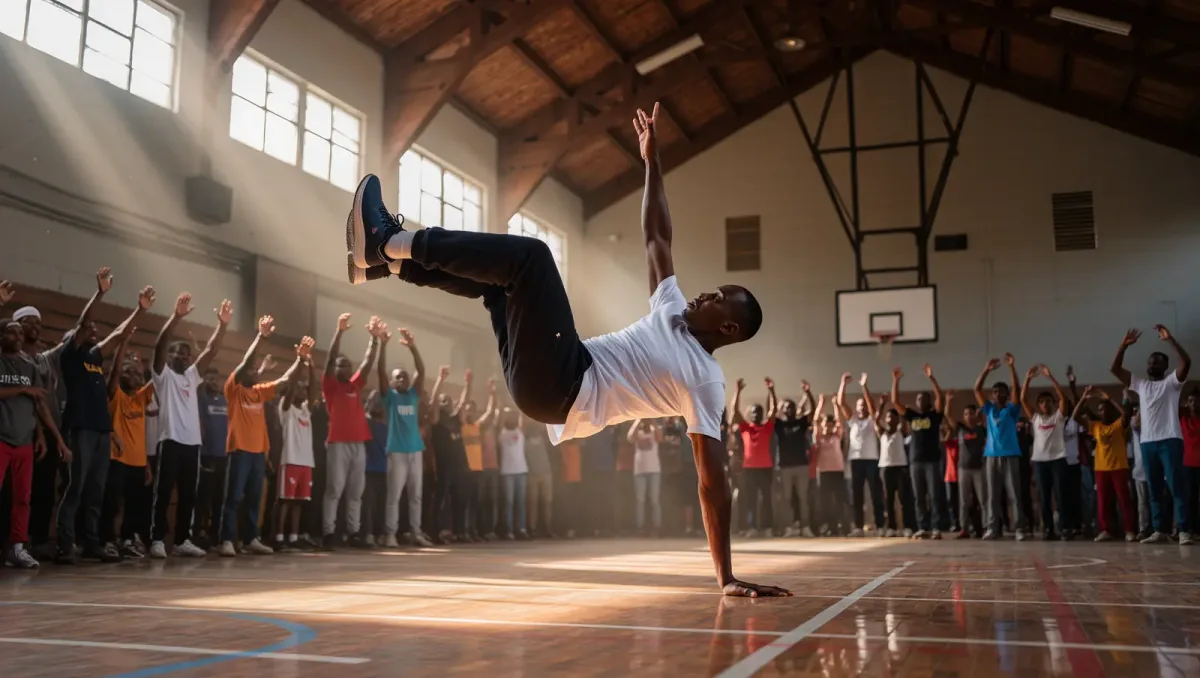
What does the Olympic debut actually change for breaking? Paris 2024 answered with specifics. Breaking competed at the Games for the first time on August 9 and 10, 2024, at La Concorde Urban Park, with B-Girl Ami of Japan and B-Boy Phil Wizard of Canada taking the first gold medals. The moment cut both ways for the scene: unprecedented visibility — and, after a widely criticized performance by Australia's Raygun generated global debate about judging and preparation, an equally public argument about whether breaking belongs in a stadium at all. The International Olympic Committee did not include breaking on the Los Angeles 2028 program, which returns the discipline's future to the circuit that built it over five decades.
This is culture and sport reporting; competitive structures described are as of early 2026.
How is a breaking battle actually judged?
Olympic breaking used the Trivium judging system, built with input from the scene, scoring rounds across five criteria commonly described as technique, vocabulary, execution, musicality and artistry. Judges press a button after each round rather than raising numbers, keeping scores anonymous until the round ends. The battle structure runs heats through brackets: Olympic events used round-robin groups feeding knockout brackets, with battles typically built from one or two rounds per dancer of roughly 40 to 60 seconds. Cypher-based formats — where dancers trade in a circle, judged by reputation and crowd response — remain the scene's root, and major independent competitions still treat the judged bracket as one format among several rather than the definition of the dance.
What is the competitive pathway now?
The pyramid has several documented levels. Local jams and cyphers feed national leagues and qualifiers; international competitions — Red Bull BC One, running its solo world final since 2003, and team events like Battle of the Year, founded in 1990 — anchor the top of the independent circuit. The Olympic cycle added a formal layer: World DanceSport Federation-administered qualifying events, world championships and continental qualification led to Paris, and national federations in dozens of countries now fund training programs for breaking athletes. With no LA 2028 slot, pathway athletes face a practical decision the scene has debated since the Games: pursue the multi-sport circuit — breaking appeared at the Youth Olympic Games in Buenos Aires in 2018 and the Asian Games — or reinvest in the independent competition economy, where prize money and street credibility both live.
What did the Olympic moment get right?
Concrete gains are easy to list. Broadcast production treated breaking as a spectator sport with instant replay and judge cams, introducing the dance to audiences that had never seen a live battle. National federations created paid coaching and training infrastructure — gym access, sports medicine, stipends — that independent jams never offered. And the qualification system gave dancers in countries with small scenes a measurable ladder: compete, rank, qualify. Athletes who came through that system, including the medalists, consistently described the Games as the largest stage any breaking event had ever occupied.
What did the scene push back on?
The friction points predate Paris and got louder after it. Codified scoring rewards certain legible moves, and dancers argue it can push training toward judge-friendly vocabulary over the conversation-with-the-DJ that defines the cypher. The Raygun controversy — a PhD-lecturer and competitive dancer whose Olympic performance scored zero across battles and became a global meme — became shorthand for the gap between institutional pathways and scene standards, and it prompted documented debate in Australia's breaking community about selection and support. The scene's core institutions responded by reasserting their own values: several major independent competitions expanded their formats and prize pools through 2024 and 2025, a counterweight to federation-only pathways.
What does training for competition look like?
The Olympic cycle formalized what top dancers already did, and the differences are worth naming. Federation-track athletes added periodized training — strength and conditioning blocks, scheduled recovery, video review of opponents — on top of the traditional training diet of weekly sessions, cyphers and jam weekends. Sports medicine became part of the conversation: national programs offered physio screening that independent dancers historically accessed only after injury. Meanwhile the scene's own development path kept its shape: learn foundations, enter beginner categories at local jams, travel to events where you lose publicly and recalibrate, and build a crew whose training sessions are the real academy. Coaches who worked both systems describe complementary value — the gym makes the body durable, the cypher makes the dancer.
How do young dancers enter the scene today?
The entry point is unchanged in structure: a local weekly session or community class, a first jam with beginner categories, and a crew. What has changed is access to information — decades of footage, breaking documentaries and live-streamed world finals mean a dancer in a small city can study the pioneers and the current leaders the same week. Community organizations and social programs use breaking as an engagement tool in dozens of countries, feeding federations and jams alike with first-time dancers. The scene's gatekeeping has also evolved from exclusion to standards: at a good jam, a beginner is welcome in the cypher, but the foundations — top rock, footwork patterns, freezes before power — are expected before the deep rounds are.
Where does breaking go from here?
Both tracks are operating in parallel as of early 2026. The federation track continues through world championships and continental games; the independent track — jams, anniversaries, crew battles — remains where the culture's terminology, etiquette and history live, and where the dance's pioneers are honored by name. For a young b-boy or b-girl the practical picture is clearer than the headlines suggest: train both ways, treat judged formats as one skill among several, and read the Olympic cycle as an accelerant, not an authority. The dance existed for fifty years without the Games, and its institutions — the jams, the crews, the cypher — are precisely what no federation can replace.