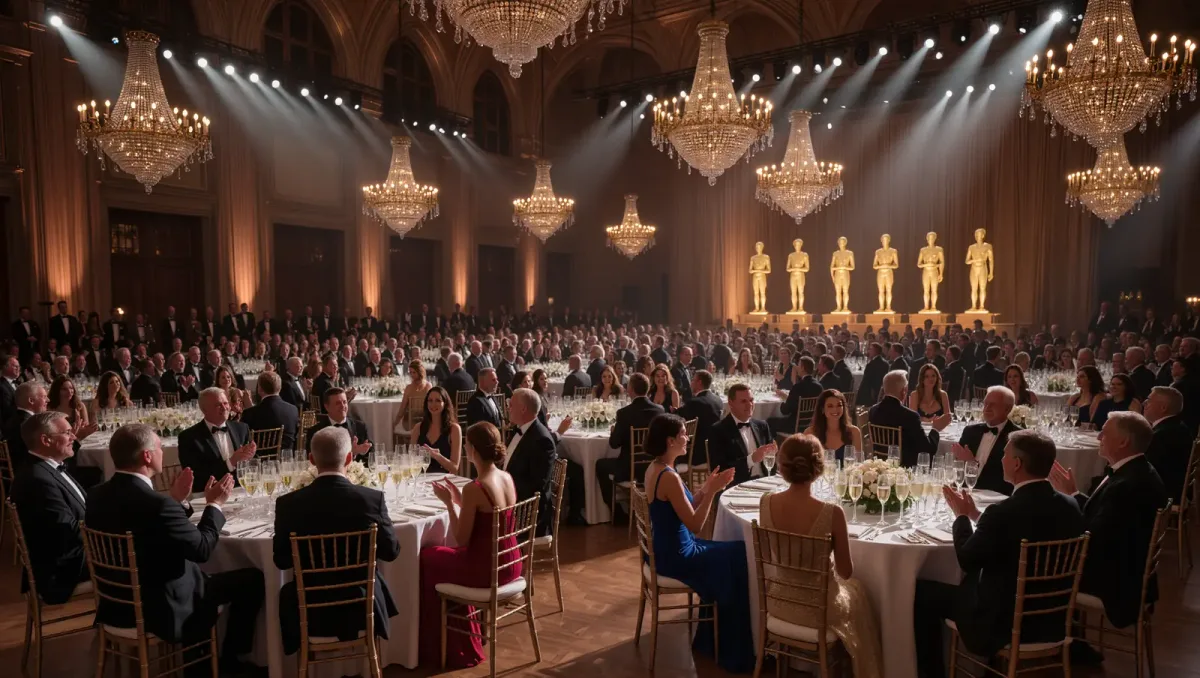
Awards season is the months-long race in which film studios court the voters who decide the Oscars. The work has a price and a rulebook. A single campaign can put up to 16 press specialists on one film, per the Guardian's industry reporting. The voter pool is small: the Academy counted 9,905 voting members as of 2024, per Wikipedia. The film that wins is the one that cleared both hurdles.
The season runs from fall festival premieres to a ceremony in February or March. The Golden Globes and the guild awards sit on the same calendar. For working performers and crews, the season shapes which films get pushed and which categories get entered. Here is how the machinery works. For related coverage, see Hamnet and One Battle After Another Split the Top Golden Globes.
Who Actually Votes for the Oscars?
The voters belong to the Academy of Motion Picture Arts and Sciences, the group behind the awards. It had 9,905 voting members as of 2024, per Wikipedia's entry. Membership is split into branches by craft. The Academy's voting rules show actors as the largest bloc, 1,258 members, about 12.7 percent of the body. Each member must be invited in by the Board of Governors.
How Are Nominees and Winners Chosen?
In late December, ballots and lists of eligible films go out, per Wikipedia. For most categories, members nominate only in their own branch. Only directors pick directors, and only actors pick actors. Best Picture works differently: all voters rank up to ten nominees in order of preference. The Best Picture winner has been picked by instant-runoff voting since 2009. The accounting firm PricewaterhouseCoopers has overseen the count since 1935.
What Does a Campaign Cost?
Film companies can spend several million dollars to market one Best Picture contender, per Wikipedia. The Guardian's reporting puts teams at up to 16 press specialists per film. Awards specialists work May through February. They earned as much as $50,000 a month plus bonuses, per the insiders the paper cited. At some studios a third of staff worked publicity, per the research firm Baseline StudioSystems. Director William Friedkin argued in 2009 that the season had become the film business's greatest self-promotion scheme.
What Rules Bind a Campaign?
The Academy enforces limits on overt campaigning. It keeps an awards official on staff to advise members and levy penalties, per Wikipedia. Ric Robertson, then the Academy's executive administrator, told the Guardian that about 15 rules governed the season. Screenings must be straight showings. No cast talk-back or dinner may be attached. Screener discs must carry the film alone. Enforcement has teeth: a producer of The Hurt Locker was barred from the 2009 Best Picture category after urging associates to back his film.
Why Do Contenders Open in the Fall?
Timing doubles the value of ordinary press. A fall release generates coverage outside the rules that govern direct campaigning. That coverage can rub off on an awards hopeful, per the Guardian's sources. The move also puts films in front of voters while ballots are fresh. The same push can serve the Globes and guild awards that share the schedule. We covered a connected angle in Upfront Week 2026: CBS Skipped the Party, and the Fall Schedule Followed.
What Changes Are Ahead?
The rulebook keeps moving. On May 1, 2026, the Academy announced planned entry rules for the 99th Academy Awards in 2027, per Wikipedia. Actors and scripts made by AI will be excluded from the acting and screenwriting categories. Campaign teams will face a fresh question that year: which made-by-people claims on a poster hold up under review.
Conclusion: Votes Are Won in Months of Small Rooms
Awards season, explained in one line, is a long election with an electorate of fewer than ten thousand people. Studios spend millions on it. Teams of specialists work the calendar from May to February. The Academy polices the line between promotion and pressure. When the envelopes open, the winner ran the smarter, cleaner campaign.